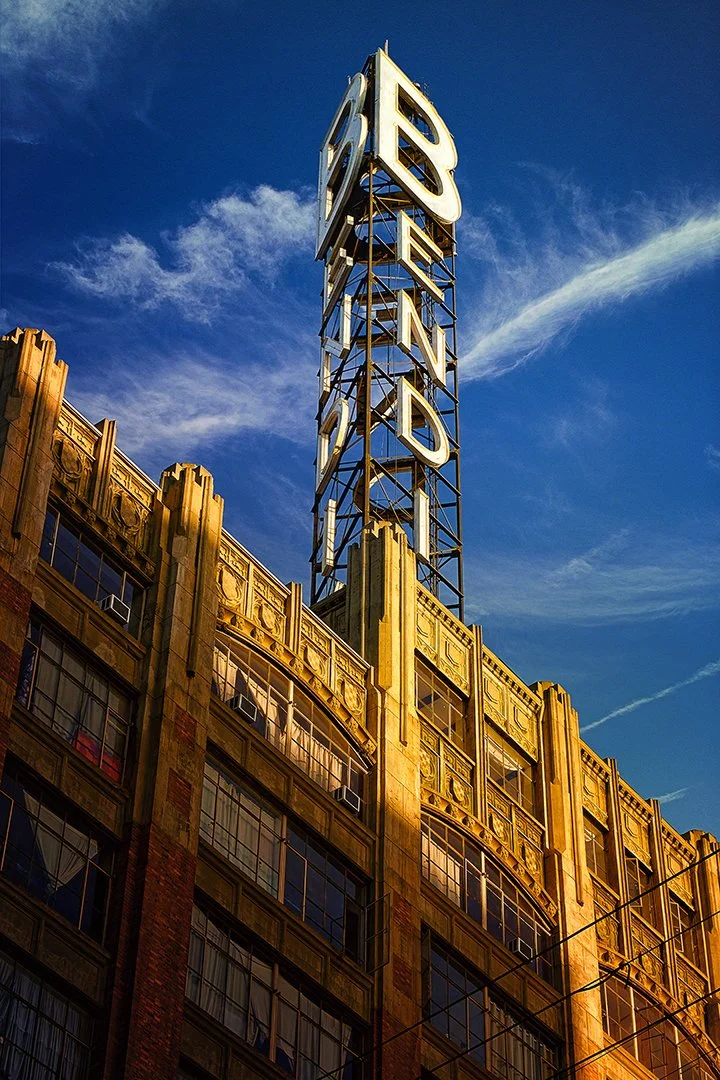
The Bendix Aviation Building-1928
Developer and Builder: Florence Casler
Style: Gothic Revival
At first glance, it’s the sign that catches your eye.
High above the street, the word BENDIX rises into the sky, each letter stacked one above the other on a steel frame as a bold, luminous sign that feels less like signage and more like a signal, something meant to be seen from afar. Just below it, another story begins to unfold. The building itself is more understated. Its surface features repeating shapes and vertical lines, catching the late sunlight as it moves across the façade. There is a steady rhythm to it, part industrial, part ornamental, recalling a time when buildings were designed to be both functional and expressive, serving the city while also giving something back to it.
When this structure first emerged in the late 1920s, it had a different name. It was called the Press Building, a project developed by Florence Casler, a businesswoman who helped shape this part of Los Angeles in ways that are easy to overlook today. Casler was not an architect but someone different, and in many respects, more unusual for her era. She was a developer and builder who organized projects, secured financing, and managed the construction of entire groups of buildings. In the area around Maple, Pico, and Santee Streets, she created a network of industrial and commercial spaces where printing, manufacturing, and trade could coexist. Her buildings were designed to be practical, flexible, and responsive to the daily activities of a growing city. The project at Twelfth and Maple, known then as the Press Building, seems to have been her most ambitious and probably a hub for her operations.
Before the building was finished, the momentum driving it forward started to weaken. Financial pressures, likely linked to broader economic shifts already beginning to unsettle the economy, intervened, and the project slipped out of Casler’s hands, going through foreclosure while still incomplete, with its future uncertain and its identity unresolved. At this point, a new vision emerged. Vincent Bendix, an industrialist who led in aviation and mechanical innovation, acquired the building and advanced it. Under his direction, it was completed and reimagined as a hub for companies involved in designing and manufacturing instruments and technologies related to flight, a different kind of network, aimed not just across the city but outward, toward the air.
At the top of the structure, the sign was raised more than a name; it became a kind of beacon, an elevated marker in the landscape, visible from afar, aligning the building with a world increasingly defined by movement, navigation, and the promise of distance overcome. The name changed. The direction shifted. And yet, the building itself remained. Its structure, its proportions, and its capacity for flexible use were part of an earlier idea, one shaped by Casler’s understanding of how a city grows and works. What Bendix added was not a replacement, but a layer: a new identity set upon an existing foundation.
Today, the Bendix Building stands as a symbol of both industry and ambition, a project that started with one vision and ended with another. Florence Casler’s name no longer appears on the building, but the work she began remains, quietly supporting the structure as it stretches upward into the sky.