The Palace/New Orpheum Theatre
Principal Architect: Gustave Albert Lansburgh
Supervising Architects: R. B. Young & Son
Sculptor: Domingo Mora
Style: Romanesque Revival
On a June evening in 1911, South Broadway stepped into a brighter future. Crowds gathered outside a newly lit Theatre, drawn by opening-night excitement and the promise of what this latest vaudeville house might offer. Seats had been auctioned off for charity; the street was alive with anticipation. When the lights came up, the building seemed to announce that Los Angeles had entered a new era. This was not simply another night at the Theatre. It was a glimpse of the city Los Angeles hoped to become.
The Palace Theatre began as the New Orpheum, a major vaudeville house built for the Orpheum Circuit on South Broadway between Sixth and Seventh streets. Its development was announced in 1909, when Orpheum leaders Morris Meyerfeld and Martin Beck promised Los Angeles “one of the finest theatrical buildings in the West.” The project was part of the circuit’s national expansion and of Broadway, where Los Angeles was beginning to define itself through shops, offices, Theatres, streetcars, and evening light.
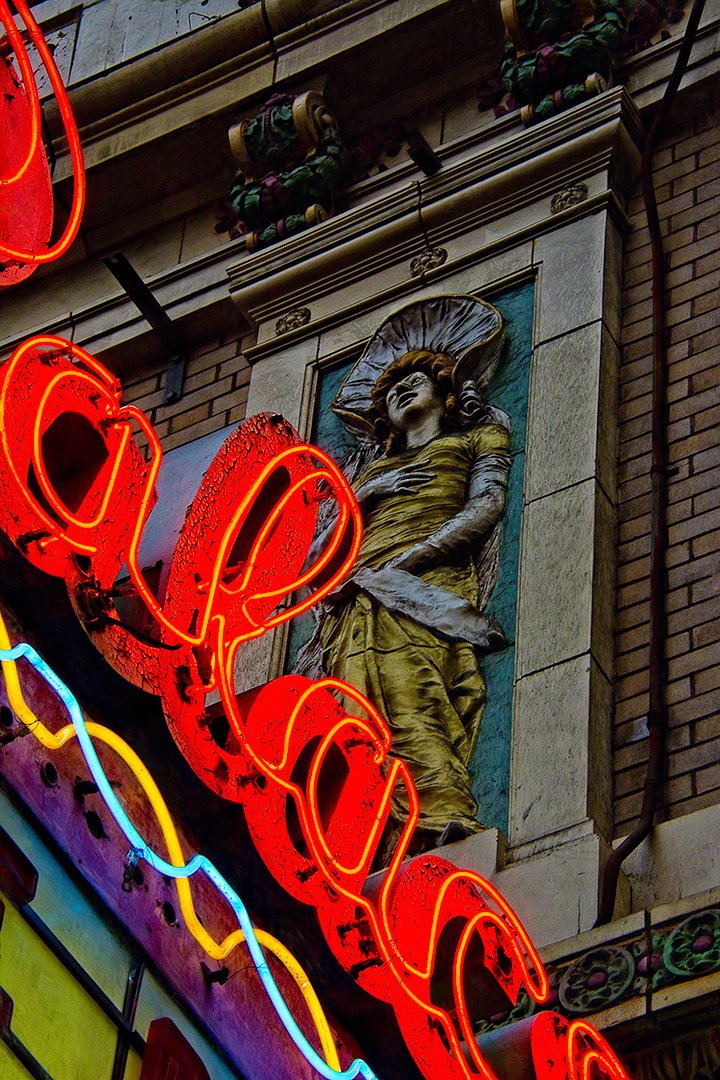
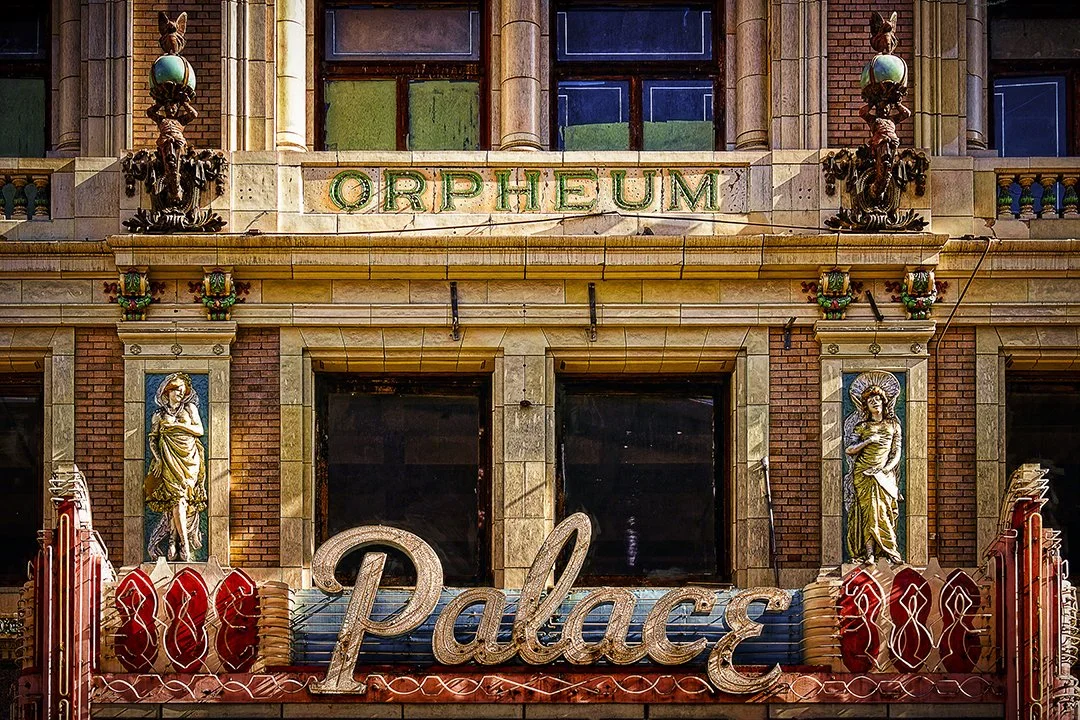
The site was secured under a fifty-year lease. The building occupied a lot 122 feet wide and 150 feet deep, extending from Broadway to an alley. From the outset, it was planned as both a Theatre and an income-generating commercial building. Stores and offices faced Broadway, while the auditorium lay behind them. Contemporary writers recognized this as one of the project’s central design problems: the architect had to show that “behind a purely commercial building was to be placed a gorgeous Theatre.” The Palace was therefore conceived as a building with two faces: one turned toward commerce, the other toward performance. The architect, G. Albert Lansburgh of San Francisco, was represented in Los Angeles by R. B. Young & Son. Lansburgh designed a facade that used color and ornament to announce the Theatre within. The exterior combined glazed tile, cream tapestry brick, and polychrome terra cotta. The Architect and Engineer described it as “the first colored facade to be erected in Los Angeles, and one of the first in the West.” Four bas-relief panels by Domingo Mora depicted Music, Song, Comedy, and Dance, giving the facade a clear purpose. The building did not simply contain vaudeville; it displayed it in color, relief, and line. The building was also a technical project. It was constructed of steel and reinforced concrete and repeatedly described as fireproof. The auditorium contained about 2,000 seats, distributed among the orchestra, balconies, boxes, and loges. Twenty-two exits led to side courts, the street, and the rear of the building. The safety system included sprinklers, fireproofed scenery and draperies, asbestos protection, and a water curtain.
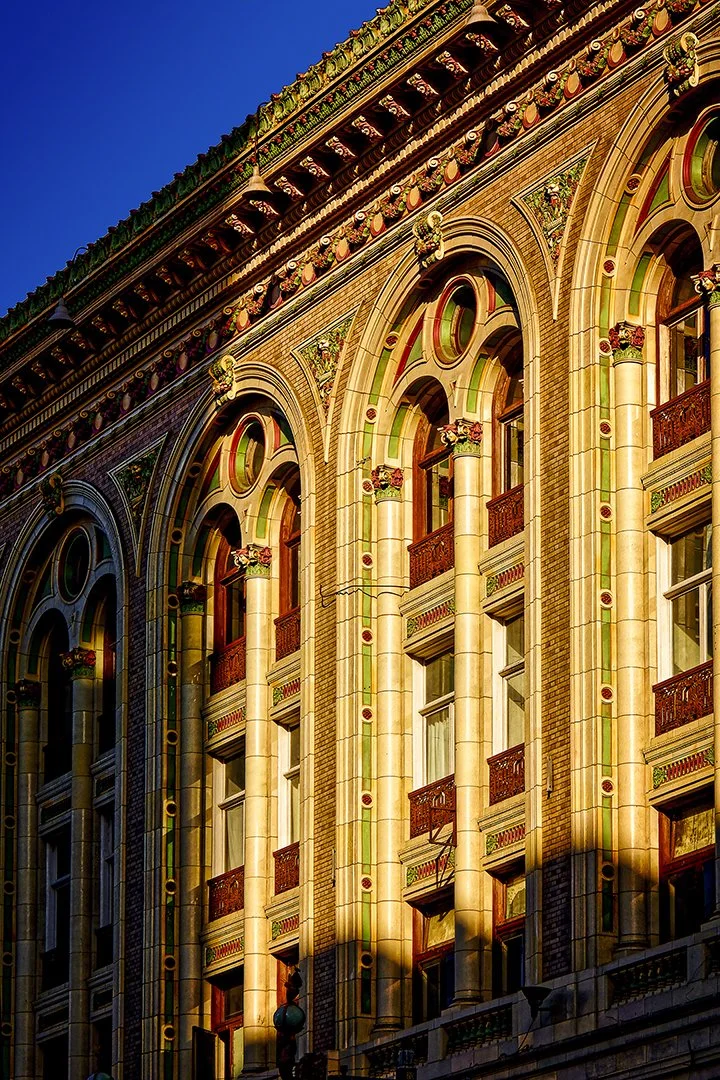
Julian Johnson’s opening-night account in the Los Angeles Times captured the building’s public effect. He wrote that no one had really seen the Orpheum until “a weary electrician” pushed a switch and “threw lobby, foyer and front into an electric conflagration.” Before that moment, the Theatre had been “a picture, a sketch, a promise”; with the lights on, “it came in the hundredth part of a second into full, glorious life.” The phrase is theatrical, but it records something real: the building was meant to be completed by illumination. Its facade needed the evening to become fully itself. Crowds gathered along the sidewalks before the performance began. Automobiles, taxis, streetcar passengers, formally dressed patrons, and gallery regulars converged on Broadway. The opening night was a composition in motion: electric light on terra cotta, people entering from the curb, ticket holders moving through the bronze doors, and the patient gallery line waiting for its turn inside. For one evening, the Theatre gathered the city around a single illuminated entrance.
Inside, the New Orpheum presented vaudeville as a modern, respectable, and carefully managed form of entertainment. Its design addressed the needs of patrons, performers, musicians, staff, and even performing animals. This was not a simple hall for variety acts. It was a complete theatrical machine, built around the movements and expectations of a modern urban audience. The Orpheum also contributed to Los Angeles’s cultural standing. By 1915, the city’s newspapers described Los Angeles as one of the country’s important Theatre centers, with more than $3,000,000 invested in first-class playhouses and a theatrical infrastructure “of strictly modern type.” The Orpheum was among the leading Theatres cited as evidence of this claim. The building later became known as the Palace Theatre. Its importance, however, was established in its first incarnation as the New Orpheum. It brought together Broadway commerce, national vaudeville, architectural display, modern engineering, and Los Angeles’s public life.
These features mattered in 1911, when Theatre fires remained a public concern, and the promise of safety helped make public entertainment feel modern and orderly. The auditorium was designed to keep the audience close to the stage. Its depth kept the room shallow, and the balconies used cantilever construction, supported by columns set well back in the house to avoid obstructing the view. Contemporary accounts emphasized that the sightlines were unusually good and that even the farthest seats remained near the performance. One article described the auditorium as “so vast, and yet so homelike, that the last row seems to be on top of the orchestra leader’s rail.” The design compressed distance, making a large room feel gathered around a single point of attention. The New Orpheum also used modern systems to enhance comfort and theatrical effect. Air was washed, heated or cooled, supplied from below the auditorium floor, and exhausted above the ceiling. Electric lighting was controlled from a large switchboard on the stage. A 1911 article called the lighting system “a story in itself” and noted that the switchboard allowed thousands of combinations of lights. The Theatre was therefore a carefully composed environment of air, light, sound, movement, and audience attention. Its machinery was hidden, yet its effects shaped every part of the experience.
The opening was set for Monday evening, June 26, 1911. Lansburgh insisted that the house would not open until it was complete. “Every last drape, chair, and bit of decoration must be absolutely complete and correct before the public is invited to see the house,” he told the press. Seats for the opening were sold in part through a charity auction for Associated Charities. The parquet, boxes, and loges were auctioned, while lower-priced balcony and gallery seats were sold in the usual way. The opening became both a theatrical event and a civic occasion.