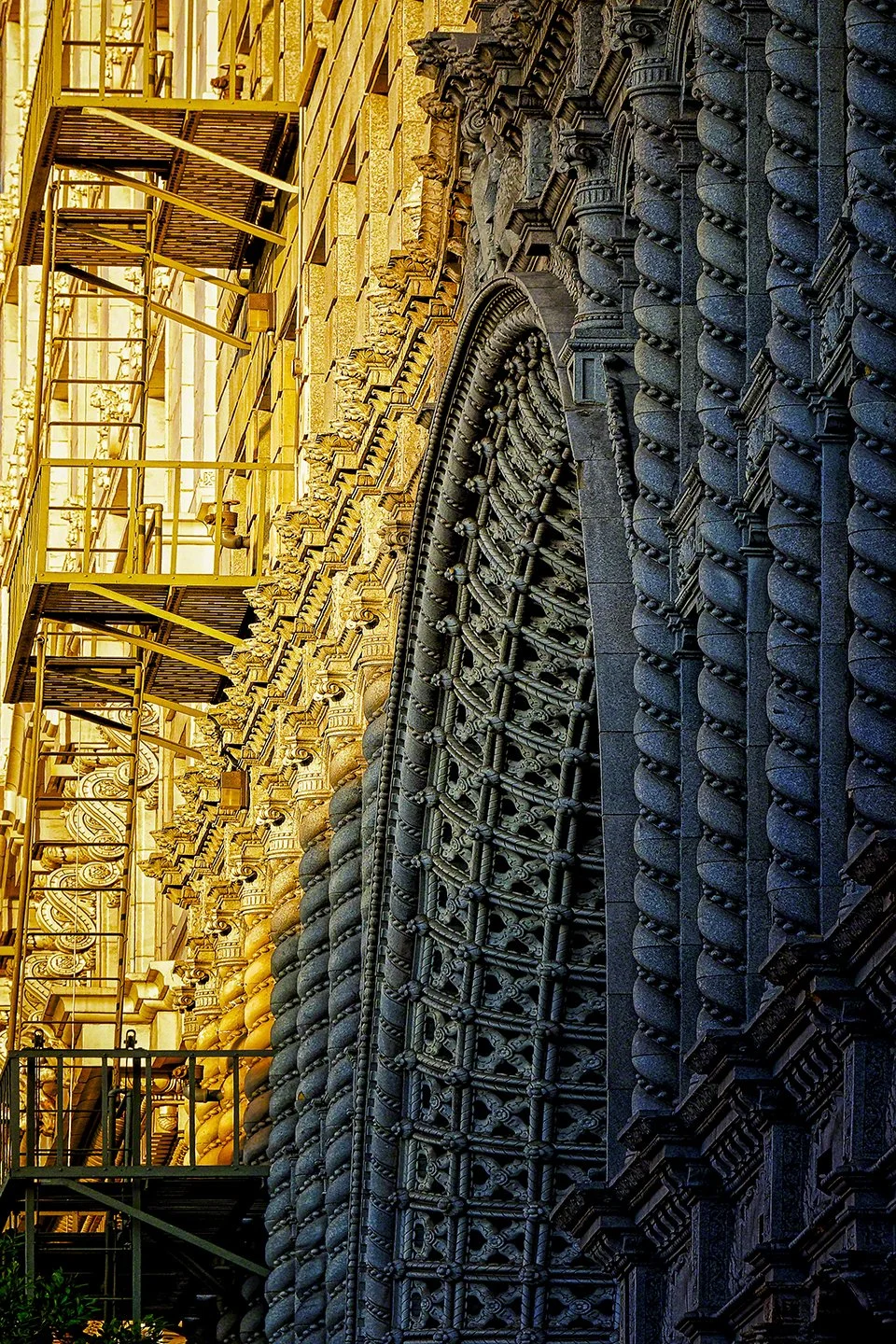
The Mercantile Arcade Building
Architect: Kenneth McDonald and Maurice Couchot
Style: Spanish Baroque, Beaux Arts
Completed in 1924, the Mercantile Arcade Building, now called the Spring Arcade Building, was constructed during a period when downtown Los Angeles was being reshaped block by block. Extending between Spring Street and Broadway, the project combined two office towers with a three-story interior arcade, forming a continuous passage through the city center. Costing roughly six million dollars, it was one of the most ambitious commercial projects on the Pacific Coast.
At its core was a simple yet powerful idea: to craft an interior street. Instead of viewing the building as a closed object, the designers opened it inward, inviting people to pass through, pause, and gather. Visitors entering from either street moved beneath a canopy of light and structure, with shops and balconies lining the edges. The experience focused less on arriving and more on moving through a sequence of spaces shaped by light, rhythm, and activity.
The design was the outcome of a competition, a process that highlighted both the significance of the site and the project’s ambition. While the architects’ names are less often remembered today, the building reveals a careful and intentional hand that is attentive not only to structure and ornament but also to the choreography of everyday life. The arcade was not just sketched; it was envisioned as something meant to be inhabited.
In this way, the building continued a longer tradition. Throughout the nineteenth century, European cities such as London, Paris, and Milan built elegant glass-covered shopping arcades that allowed pedestrians to move comfortably between busy streets while browsing shops. The Mercantile Arcade brought this idea into the context of a growing American city, transforming the passageway into something larger, more vertical, and more connected to the pace of commerce.
The site itself showed signs of an earlier Los Angeles. For decades, it was owned by the Board of Education, initially functioning as a school and later housing smaller commercial buildings that, over time, began to feel out of scale with the expanding city around them. In 1922, developer A. C. Blumenthal and his partners acquired the property, seeing an opportunity to create something that matched the scale and energy of the era.
Construction progressed quickly, almost with a sense of urgency. In just one year, the building rose from the ground, showcasing not only ambition but also increasing technical confidence. Beneath the visible surfaces, engineers undertook complex foundation work to secure the structure within a crowded urban block. What looked easy and open above ground was supported by careful and often unseen labor below.
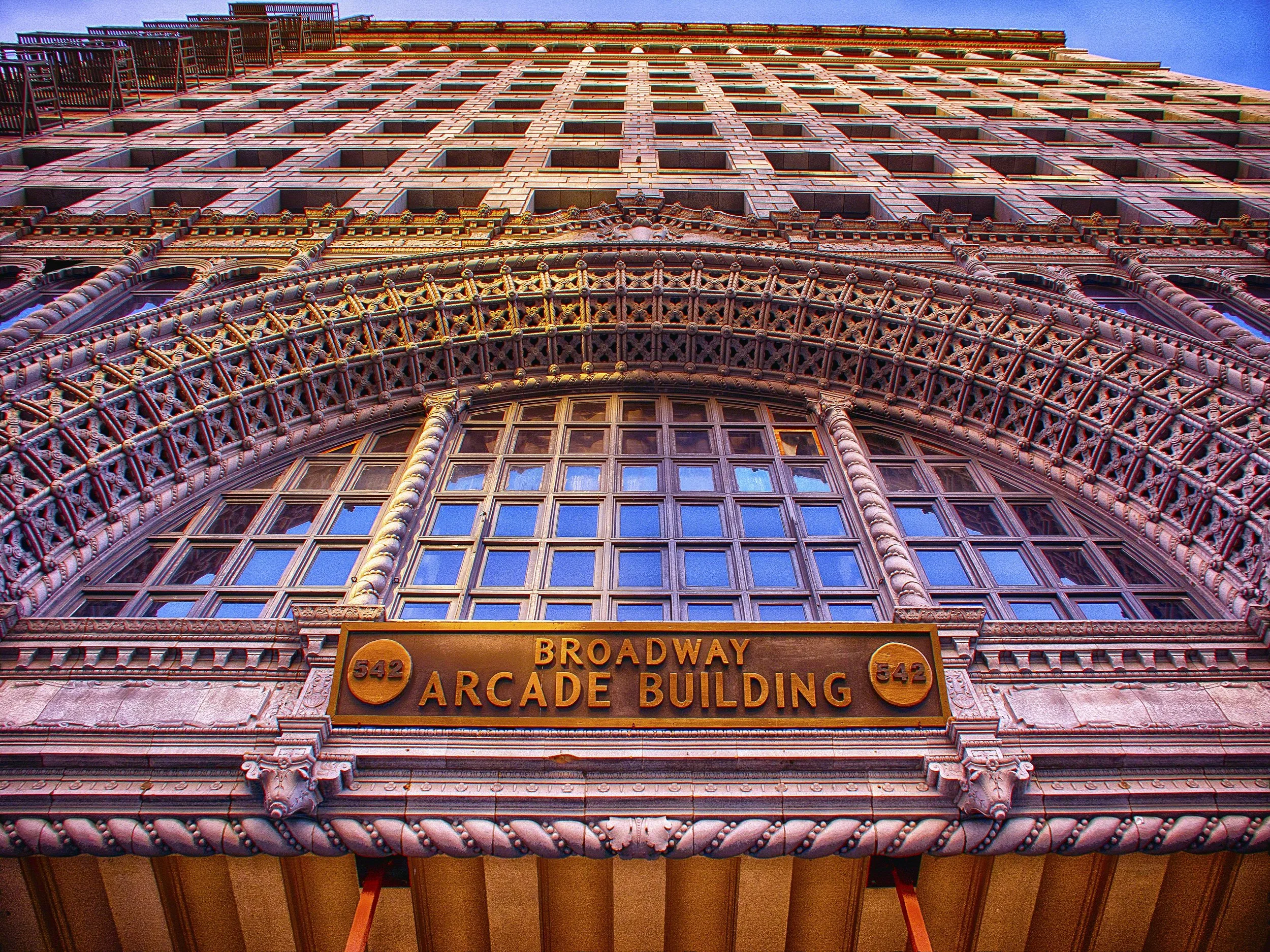
Before opening to the public, the building was unveiled during an evening of ceremony and celebration on February 14, 1924. Nearly four thousand guests were invited to walk its halls for the first time. Music filled the arcade, speeches commemorated the event, and the space, still new and unfamiliar, briefly became a stage for the city to gather and recognize itself.
Under this movement and light, a different kind of space unfolded below. The entire basement of the building was dedicated to a large cafeteria managed by Leighton Cooperative Industries. Here, the scale changed, but the goal stayed the same: to create a space not just for functioning, but for shared experience. Thousands of people could pass through each day, moving along long counters, choosing meals, and finding seats in a dining area decorated with oak paneling, marble floors, and soft, filtered light.
There was a quiet generosity in this design. The building did not separate work, shopping, and daily life into isolated sections. Instead, it brought them together above, within, and below so that moving through the space became part of a larger rhythm. One could go from the street into the arcade, from the arcade into the offices, and from there down to a spot to pause, eat, or linger a moment within the life of the city.
Today, the Spring Arcade Building still shows traces of that purpose. Walking inside, one notices not only the architecture but also the idea behind it: that a building can do more than just hold activity; it can influence how people move, meet, and experience the city around them. More than a century later, the arcade remains what it was at the start: a passage, a gathering spot, and a quiet reflection of the city learning how to become itself.